
Lionel Messi: From a Little Boy in Rosario to an Emotional Goodbye to Argentina
There are football careers that are measured in goals, trophies and records. Then there are careers that become part of a country’s history, carrying emotions and memories that remain with generations of supporters.
Lionel Andrés Messi’s story with Argentina was never simply about football. It was a journey filled with dreams, criticism, heartbreak, perseverance, redemption and, eventually, an emotional goodbye. For more than two decades, Messi wore Argentina’s famous blue-and-white shirt and experienced almost every emotion the game could offer — from painful defeats and criticism to Copa América triumphs and the ultimate World Cup victory.
On October 6, 2026, that extraordinary international journey finally came to an end. At the Monumental Stadium in Buenos Aires, in front of more than 85,000 supporters, Messi played his final match for Argentina against Benin. He scored, created opportunities for his teammates and eventually stood before the Argentine supporters with tears in his eyes.
The little boy from Rosario had finally said goodbye.
Lionel Messi — At a Glance
Full Name: Lionel Andrés Messi
Born: June 24, 1987
Birthplace: Rosario, Argentina
Position: Forward / Attacking Player
Argentina Debut: 2005
International Career: More than two decades
World Cup Titles: 1 — 2022
Copa América Titles: 2 — 2021 & 2024
Finalissima: 1 — 2022
Argentina Goals: 126
Argentina Appearances: 208
Jersey Number: 10
Known For: Dribbling, playmaking, goalscoring and extraordinary vision
A journey from a young boy in Rosario to Argentina’s World Cup-winning captain — and finally an emotional farewell to the national team.
The Beginning: A Small Boy With a Big Dream
Lionel Messi was born on June 24, 1987, in Rosario, Argentina. His love for football appeared at a very young age, and by the time he was six, he was already playing organized football in Rosario. He eventually joined Newell’s Old Boys, where his extraordinary ability with the ball quickly became obvious.
Messi’s childhood, however, was not completely easy. He was diagnosed with a growth-hormone deficiency, and his family had to face the difficult reality of expensive medical treatment. Despite his small physical stature, his football ability was impossible to ignore.
At the age of 13, Messi moved from Argentina to Spain and joined Barcelona’s famous La Masia academy. It was a huge change for a young boy who had to leave his hometown, friends and familiar surroundings behind. Barcelona would eventually become his football home, but the dream of representing Argentina remained deeply important to him.
The boy who had once looked too small to succeed was about to begin one of football’s greatest stories.
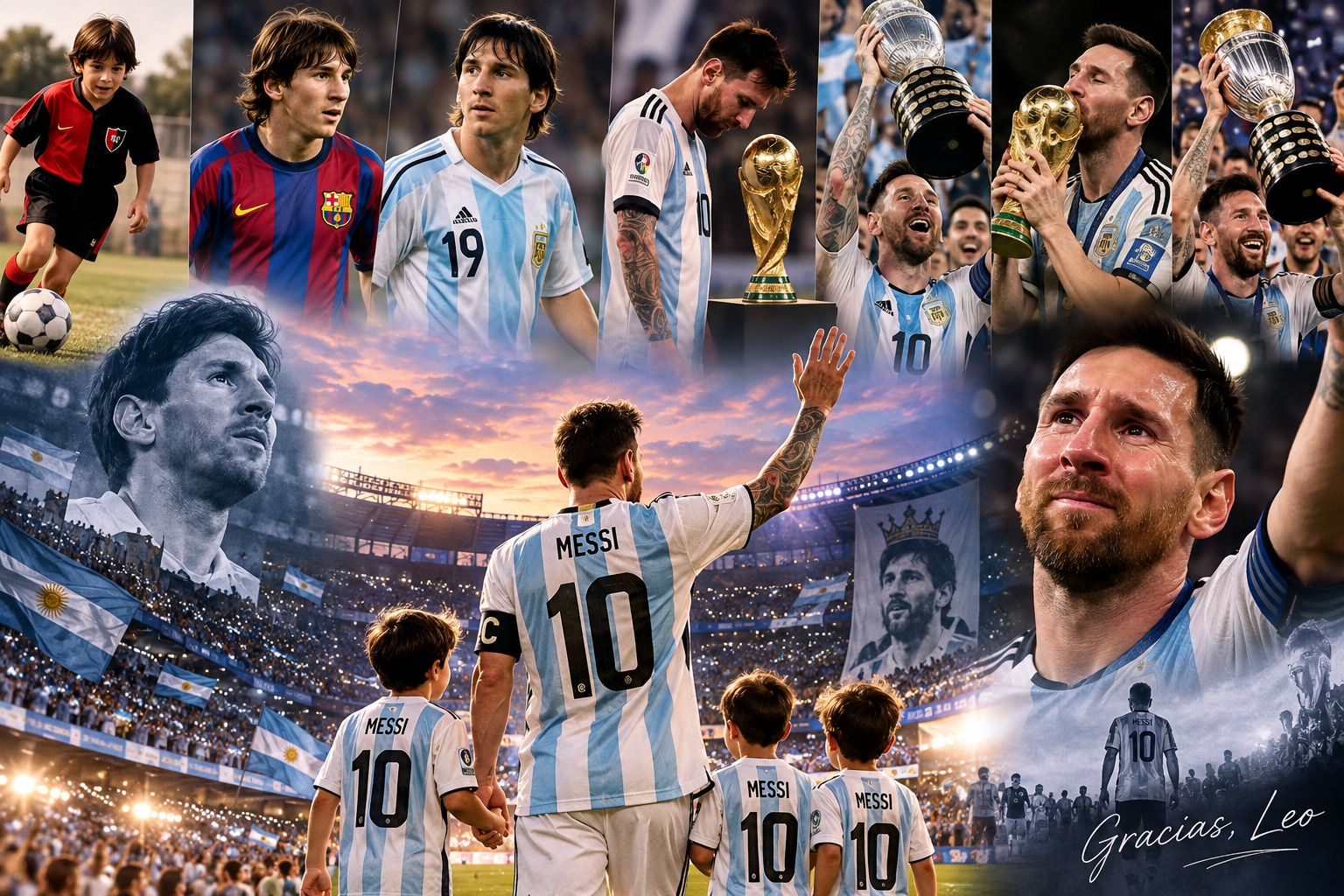
The End of an Era
From La Masia to Barcelona’s First Team
Messi progressed rapidly through Barcelona’s youth system. He made his first-team debut in a friendly against Porto in 2003 when he was only 16, before making his official Barcelona debut against Espanyol on October 16, 2004, at the age of 17.
Nobody watching that young substitute could have known what was coming. Messi would eventually become the heart of one of the greatest eras in Barcelona’s history.
During his Barcelona career, he made 778 first-team appearances and scored 672 goals, while winning 10 La Liga titles and four Champions League trophies among numerous other honours. Yet while Barcelona became his professional home, Argentina represented something much more personal.
Argentina was his dream, but it would also become the source of some of the most painful moments of his career.
The Argentina Dream Begins
Messi made his senior Argentina debut on August 17, 2005, against Hungary. His international career could hardly have started in a stranger way: he entered the match as a substitute and was sent off less than a minute later.
That unusual beginning was only the first chapter of what would become a 21-year international career. Only weeks earlier, Messi had helped Argentina win the FIFA Under-20 World Cup in the Netherlands, scoring six goals, including two in the final against Nigeria, while winning both the Golden Ball and Golden Boot.
The signs were already there. Argentina had discovered another extraordinarily talented player.
The Young Messi at the 2006 World Cup
The 2006 FIFA World Cup in Germany introduced Messi to the world on football’s biggest stage. He scored against Serbia and Montenegro and became the youngest Argentine player to score at a World Cup at that time.
Argentina eventually lost to Germany on penalties in the quarter-finals. Messi was only 19, and although he was still at the beginning of his international career, the first World Cup disappointment had already arrived.
There would be many more World Cups in his future, but there would also be more heartbreak.
The Pressure of Being Messi
Being Lionel Messi was never easy, particularly when he played for Argentina. At Barcelona, he was surrounded by world-class teammates and became the centre of one of the most successful teams in modern football. With Argentina, however, every match carried the weight of history and expectation.
Argentina had Diego Maradona, a figure who had already delivered the World Cup to the country. Many supporters wanted Messi to achieve something similar, and every time Argentina suffered a major defeat, questions were raised about whether Messi could reproduce his Barcelona success with the national team.
Could he win a major international trophy? Could he lead Argentina to another World Cup? For years, the answers appeared to be no. Yet Messi kept returning, kept wearing the captain’s armband and kept trying.
2014: So Close to the World Cup
The 2014 World Cup in Brazil became one of the most important chapters of Messi’s international career. Argentina reached the final, with Messi serving as captain and the central figure of the team.
But at the Maracanã, Germany defeated Argentina 1-0 after extra time. Messi received the Golden Ball as the tournament’s best player, but the individual award could not replace the trophy he desperately wanted.
The image of Messi walking away from the World Cup final without the trophy became one of the defining images of his career. He had come incredibly close, but once again, the biggest prize had escaped him.
2015 and 2016: More Heartbreak
The disappointment continued over the next two years. Argentina reached the Copa América final in 2015 but lost to Chile on penalties, and one year later, at the Copa América Centenario, Argentina again reached the final before suffering another penalty-shootout defeat to Chile.
For Messi, the repeated disappointments became overwhelming. After the 2016 final, he announced that he was stepping away from international football. For a moment, it appeared that his Argentina story might already be over.
He had played in major tournaments, reached finals and scored countless goals, but he had still not won the major trophy Argentina wanted. The criticism surrounding him had also become extremely difficult to escape.
“I Have Nothing Left to Give”
Messi eventually returned to the Argentina national team, and that decision changed the direction of his international career. He continued fighting, continued wearing the captain’s armband and continued believing that success with Argentina was still possible.
Eventually, the trophy that had escaped him for so long finally arrived.
2021: Messi Finally Wins the Copa América
The 2021 Copa América became a major turning point in Messi’s international career. Argentina reached the final against Brazil at the Maracanã, the same stadium where Messi had experienced heartbreak years earlier.
Ángel Di María scored the only goal of the match, giving Argentina a 1-0 victory. Messi finally had his first major senior international trophy.
The celebration was enormous, not only because Argentina had won, but because of what the victory meant for Messi personally. For years, critics had asked whether he could win something important with Argentina. Now he finally had the answer.
The victory also changed the relationship between Messi and Argentine supporters. The criticism that had followed him for years gradually turned into admiration, affection and respect.
2022: The Dream Becomes Reality
Then came Qatar.
The 2022 FIFA World Cup became the defining chapter of Messi’s international career. Argentina lost its opening match against Saudi Arabia, immediately creating another cloud of doubt around the team. But Messi and his teammates responded by defeating Mexico and Poland before progressing through the knockout stages.
Argentina overcame Australia, the Netherlands and Croatia to reach the final. Waiting for them was France.
The Greatest Final of His Life
The 2022 World Cup final became one of the most dramatic matches in football history. Messi scored twice as Argentina and France battled through 120 unforgettable minutes, eventually finishing 3-3.
The World Cup had to be decided by penalties.
Argentina won.
Lionel Messi finally lifted the FIFA World Cup trophy, completing the dream that had followed him throughout his international career. The image of Messi holding the trophy above his head became one of the defining sporting images of the 21st century.
The little boy from Rosario had achieved the dream.
The player who had spent years being questioned about his international record was now a World Cup champion. More importantly, Argentina finally embraced him completely. Messi no longer needed to be compared with Maradona to establish his place in history; he had written his own chapter.
2024: Another Copa América
Messi’s Argentina story still wasn’t finished. At the 2024 Copa América, Argentina reached the final against Colombia and won 1-0 after extra time.
Messi lifted another Copa América trophy, adding to the 2021 title, the 2022 World Cup and the Finalissima. His international career had transformed from years of disappointment into an era of remarkable success.
The player who once wondered whether he could win anything with Argentina was now collecting major international trophies.
2026: One Last World Cup
Then came the 2026 FIFA World Cup. At 39, Messi entered his sixth World Cup, an extraordinary achievement in itself.
Argentina reached the final once again, but the fairy tale did not have the ending many fans wanted. Argentina lost the World Cup final to Spain 1-0 after extra time.
For Messi, it was another painful World Cup final. But this time there was an important difference: he had already achieved what he had spent most of his life chasing.
He had already lifted the World Cup.
There was nothing left to prove.
Messi Announces His International Retirement
After the 2026 World Cup, Messi confirmed that his time with Argentina was coming to an end. His farewell message was deeply personal, reflecting on the enormous importance of the national team throughout his career.
He explained that the decision hurt him, but he understood that it was time. He said that he had always given everything for the Argentina shirt and that he was leaving with pride because of what he and his teammates had achieved.
He also recognized that younger players deserved their opportunity. The Argentine Football Association published his farewell message, in which Messi thanked his family, teammates, coaches and supporters and expressed his enduring love for Argentina.
He ended with a simple expression of national pride:
“Gracias Dios por hacerme argentino.”
“Thank you, God, for making me Argentine.”
October 6, 2026: The Night Nobody Wanted to End
And then came the night everyone knew would eventually arrive.
Argentina played Benin in a farewell friendly at the Monumental Stadium in Buenos Aires, with more than 85,000 supporters filling the stadium. This was not simply another football match. It was the final time Lionel Messi would wear the Argentina shirt.
The atmosphere was emotional even before the game began. Fans arrived wearing the famous No. 10 shirt, tributes were prepared throughout the stadium, and messages of thanks appeared across Argentina.
The night was built around one simple word:
Gracias.
Thank you, Messi.
Messi Walks Out With His Children
Before the match, Messi entered the stadium with his children. The sight made the occasion even more emotional because Argentine supporters had watched him grow from a teenage footballer into a father, captain, World Cup winner and national icon.
Now his children were there to watch him say goodbye to the national team.
It was no longer simply a football farewell. It felt like the closing of a family chapter and the end of an era that had lasted more than two decades.
Messi’s Final Argentina Match
Argentina defeated Benin 3-0, and Messi managed to make his final night feel like a typical Messi performance. He assisted Nicolás Otamendi for Argentina’s first goal, helped create another for Nico Paz and then scored himself from the penalty spot.
It was his 126th international goal.
His final Argentina match ended with everything supporters had come to expect from him: creativity, goals, leadership and the ability to make a difference. After the final whistle, however, the football became secondary. Everyone knew what the night really meant.
Then Came the Tears
The final whistle felt different because there was no next match waiting for Messi. There would be no next World Cup, no next Copa América and no next night when the stadium would roar as he walked onto the pitch wearing Argentina’s No. 10.
Messi stood on the field surrounded by his teammates. Players hugged him, fans applauded and eventually the emotions became impossible to hold back.
Messi cried.
His teammates cried, and the supporters shared the emotion. For a footballer who had spent 21 years representing Argentina, this was the moment when the reality finally arrived: it was over.
Messi’s Final Speech
Messi then took the microphone, visibly overcome by emotion. He spoke about his father and everything that was going through his mind, while also reflecting on the incredible honour of wearing the Argentina shirt for more than two decades.
He explained that not returning and no longer being part of the Argentina national team would hurt him deeply. He also admitted that, if he could choose, he would love to keep coming back for the rest of his life because playing for Argentina was the most beautiful thing he could experience.
One of the most powerful lines from his farewell was:
“Playing for Argentina is the most beautiful thing that can happen to you.”
That sentence captures why Messi’s relationship with Argentina became so complicated and so special. He did not simply play for the national team; he genuinely loved representing his country.
It Started With Tears — And It Ended With Tears
There is something almost poetic about Messi’s Argentina story because it began with tears and ended with tears.
In 2005, his senior international debut against Hungary lasted only seconds before he was sent off. Twenty-one years later, his final Argentina match ended with Messi crying again, but these were completely different tears.
The young Messi’s difficult beginning was followed by years of questions, criticism and disappointment. The older Messi cried because the dream he had spent his entire career chasing had finally been fulfilled, and now it was time to leave.
His journey had come full circle.
From Argentina’s Most Criticized Player to Its Beloved Captain
Perhaps the most remarkable part of Messi’s journey was not the number of goals or trophies. It was the transformation in his relationship with Argentina.
For years, he was asked why he could not reproduce his Barcelona success with the national team. He was constantly compared with Maradona, lost major finals and eventually even stepped away from international football.
But he returned.
He kept going.
Eventually, he won the Copa América, then the Finalissima, then the World Cup and another Copa América. The player who once walked away from international football eventually became Argentina’s record appearance-maker and leading scorer.
At his farewell, the country was no longer asking Messi to prove himself.
It was simply saying:
Thank you.
Messi’s Argentina Legacy
Messi leaves the Argentina national team after an international career that lasted more than 21 years. His final numbers include 208 Argentina appearances, 126 international goals, two Copa América titles, one FIFA World Cup, one Finalissima, six World Cup appearances and seven Copa América appearances, while he served as Argentina’s captain for much of his later career.
He also leaves as the player with the most appearances in Copa América history, with 39, and scored 14 goals in the competition.
But numbers can only tell part of the story.
The real legacy is emotional.
The Boy From Rosario Never Gave Up
When Messi was 13, he left Argentina for Spain. He was small, far from home and dealing with a medical condition that required treatment. There were doubts about whether he would succeed, but he kept playing.
He became a Barcelona legend, one of football’s most decorated players and eventually Argentina’s captain. He lost finals, cried, briefly retired and came back.
Then he won the Copa América.
He won the World Cup.
He won another Copa América.
And finally, at the age of 39, he walked away from Argentina football — not because he had failed, but because every chapter eventually has an ending.
A Goodbye to No. 10
For generations of Argentine supporters, the No. 10 shirt meant Diego Maradona.
Then it became Messi’s.
For more than two decades, children around the world grew up watching Messi wear that number. They copied his celebrations, tried his famous dribbles, shouted his name and watched him lift trophies.
Now they have watched him say goodbye.
The next generation of Argentine footballers will have to create their own story. Nobody can truly replace Lionel Messi, but they can inherit what he left behind: the belief that talent matters, but perseverance matters too.
Messi’s Final Message Wasn’t Really Goodbye
Messi may no longer play for Argentina, but his connection with the country will not disappear. He will remain part of its football history and will always be remembered as the captain who helped bring the World Cup back to Argentina.
He will also remain the little boy from Rosario who crossed the Atlantic and eventually became one of the greatest symbols in Argentine football.
Perhaps that is why the farewell was so emotional. The supporters were not only saying goodbye to a football player; they were saying goodbye to a period of their lives.
For 21 years, Lionel Messi was there.
Now he isn’t.
The End of an Era
On October 6, 2026, Lionel Messi walked onto the pitch for Argentina one final time. He scored, assisted, celebrated and cried before speaking to the people who had followed him through every high and every low.
The journey that began with a little boy kicking a football in Rosario had reached its final international chapter in Buenos Aires. There were no more questions to answer, no more trophies to chase with Argentina and no more criticism to silence.
Only gratitude remained.
As Messi stood inside the Monumental, surrounded by thousands of supporters, Argentina was not simply saying goodbye to a footballer. It was celebrating a player who had given the country some of its most unforgettable sporting memories.
The little boy from Rosario became a World Cup champion. The criticized teenager became a captain. The player who once walked away became the man who gave Argentina its greatest football memories.
And when he finally left the field, he left behind something far more valuable than records.
He left behind a story — a story of dreams, heartbreak, perseverance and Argentina.
A story of Lionel Messi.
For millions of football fans around the world, the final word will always be the same:
Gracias, Leo. 🇦🇷❤️
Sources
This article is based on reporting and historical information from FIFA, the Argentine Football Association, FC Barcelona, AP/Reuters and other contemporary reports.